📞 Call 01604 913229 — Free Estimate
Flat Roofing vs Pitched Roof — Which Is Right for Your Northampton Extension?
Flat roofing is one of the most common roofing questions we get asked by Northampton homeowners planning extensions or replacing an existing roof on a single-storey addition. The choice between a flat roof and a pitched roof affects the cost of the build, the appearance of the finished extension, the maintenance requirements over its lifetime, and in some cases whether planning permission is required. This guide sets out the key differences so you can make an informed decision before committing to either option.
What Is a Flat Roof?
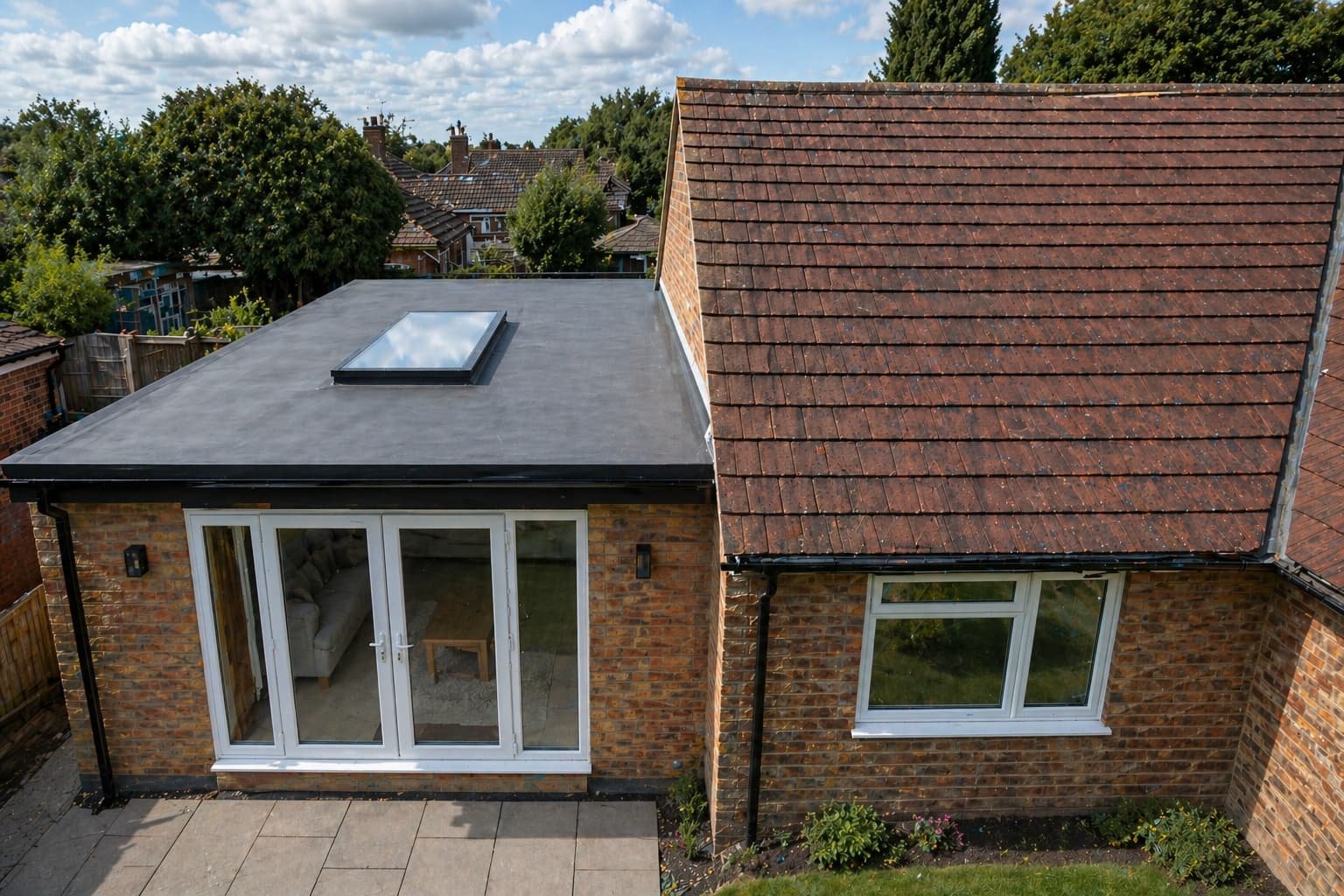
A flat roof is not truly flat — it has a slight fall built in to allow rainwater to drain to one edge rather than pond across the surface. The minimum recommended fall is 1:80, though 1:40 is the standard target for EPDM and GRP installations. Flat roofs are structurally simpler than pitched roofs, require less material, and are quicker to install — which makes them the more cost-effective choice for single-storey extensions where the roof area is not visible from the street or neighbouring properties.
The reputation flat roofs have for leaking is largely a legacy of the old felt systems installed on extensions built between the 1950s and the 1990s. Felt has a maximum reliable lifespan of 15 to 20 years and is vulnerable to UV degradation, ponding water, and the freeze-thaw cycling that is a consistent feature of the East Midlands climate. Modern flat roofing systems — EPDM rubber and GRP fibreglass — are categorically different products with lifespans of 25 to 50 years and a failure rate that is not meaningfully higher than a well-installed pitched roof.
EPDM Flat Roofing
EPDM (ethylene propylene diene monomer) is a synthetic rubber membrane that has become the dominant flat roofing system for residential extensions across the UK. It is supplied in large sheets, fully adhered to the deck, and welded at all seams, upstands, and perimeter edges. EPDM handles UV exposure, temperature extremes, and ponding water better than any previous flat roofing material, and a correctly installed system requires no maintenance beyond an annual visual inspection. Manufacturer-backed warranties of 20 years are standard, with realistic lifespans of 40 to 50 years on well-installed systems.
GRP Fibreglass Roofing
GRP (glass reinforced polyester) fibreglass is a rigid, seamless system applied in-situ to the roof deck. A fibreglass laminate is laid over the prepared deck and finished with a pigmented topcoat that provides UV protection and a hard, clean finish. GRP is particularly well suited to roofs with multiple upstands, roof lights, or complex geometry where a membrane system would require a large number of seams. It is the preferred flat roofing system for many architects and builders working on new extensions, and it carries the same long manufacturer warranties as EPDM.
What Is a Pitched Roof?
A pitched roof has a slope steep enough to shed water directly into the guttering without requiring a built-in fall in the deck. Pitches of 17.5 degrees and above are considered standard for most tile and slate systems. A pitched roof on an extension is more expensive than a flat roof of the same plan area — it requires more material, more labour, and typically more scaffolding — but it offers some advantages in the right circumstances. A pitched roof that matches the main house roof in pitch, tile profile, and colour integrates the extension more seamlessly into the existing building, which can be a planning requirement in some conservation areas and is generally preferable aesthetically on older properties.
Planning Permission Considerations
In many cases, single-storey rear extensions fall within permitted development rights and do not require planning permission — regardless of whether the roof is flat or pitched. However, properties in conservation areas, listed buildings, and some Article 4 direction areas have additional restrictions, and the roof design can affect whether permitted development applies. It is always worth checking with West Northamptonshire Council before committing to a roof specification if your property is in or near a conservation area. The planning portal at planningportal.gov.uk provides a useful interactive guide to permitted development rules for householder extensions.
Which Should You Choose?
For most single-storey rear extensions on Northampton’s post-war housing stock, a modern flat roof in EPDM or GRP is the practical and cost-effective choice. It is quicker to install, less expensive, and — with modern systems — as durable as a pitched roof over its lifetime. A pitched roof makes sense where the extension is visible from the front of the property, where planning requirements specify it, or where the homeowner wants the extension to blend seamlessly with a steeply pitched main roof. We advise on the right option for your specific property and planning situation during the free estimate visit.
Free Flat Roofing Estimates Across Northampton
We install and replace flat roofs across Northampton, Wellingborough, Kettering, Daventry, Towcester, and surrounding villages. EPDM and GRP systems, free estimates, fixed prices, payment on completion. Call 01604 913229 or use the estimate form below.